All published articles of this journal are available on ScienceDirect.

Knowledge, Perceptions, and Attitudes Toward Heart Attack and Anaphylaxis Among Healthcare Students and Clinicians: A Cross-Sectional Comparative Study
 iD
Indrayadi Gunardi2 , 3 , 4 , #
iD
Aryadi Aryadi5 , *
iD
Yohana Yusra6
iD
Jamison Wijaya7
Julvyn7
Wita Anggraini8
iD
Elizabeth Fitriana Sari9
iD
iD
Indrayadi Gunardi2 , 3 , 4 , #
iD
Aryadi Aryadi5 , *
iD
Yohana Yusra6
iD
Jamison Wijaya7
Julvyn7
Wita Anggraini8
iD
Elizabeth Fitriana Sari9
iD
Authors Info & Affiliations
Abstract
Background
Basic Life Support (BLS) knowledge and readiness to act are essential first-line competencies for healthcare professionals. BLS training is frequently integrated into medical and dental curricula to enhance preparedness for emergencies. This study aimed to evaluate knowledge, perceptions, and attitudes toward heart attack (HA) and anaphylactic shock (AS) among different professional groups.
Materials and Methods
This cross-sectional study involved 1,083 participants who completed an online, validated questionnaire comprising 39 items on HA and AS across three domains: knowledge, perception, and attitude. Data were analyzed using ANOVA, Rasch modeling, bootstrap mediation analysis, and linear regression.
Results
The majority of participants were female (77.1%), with dental students representing the largest subgroup (69.9%). Significant differences were observed among groups in past learning experiences related to HA (p=0.019) and AS (p<0.001), as well as in the corresponding modes of learning (both p<0.05). Medical students demonstrated the highest scores in knowledge (25.47±1.02) and perception (55.36±5.40), whereas dental students had the lowest scores across all domains.
Discussion
Perception significantly mediated the relationship between knowledge and attitude (p < 0.001). Participants with a family history of HA or AS showed higher knowledge scores (p<0.05), and gender significantly influenced attitude (p=0.004).
Conclusion
Knowledge, perceptions, and attitudes regarding heart attack and anaphylactic shock may differ across dental and medical students and professional groups, with dental students showing the lowest scores and medical students the highest. This finding highlighted the need for targeted, interdisciplinary, simulation-based BLS training, especially for dental students.
1. INTRODUCTION
Prompt recognition and management of acute emergencies, such as myocardial infarction (or heart attack) and anaphylactic shock, can significantly reduce morbidity and mortality. Basic life support knowledge and readiness to act are critical first-line capabilities among healthcare providers [1-3]. Training in basic life support is often integrated into medical and dental curricula to enhance readiness in emergencies [4, 5].
Despite this, studies across various countries have reported persistent gaps in knowledge, perception, and attitudes among healthcare students and professionals. For example, Ahmed et al. (2025) found that a large proportion of health professional students in Bangladesh demonstrated inadequate BLS knowledge, although prior exposure to emergency courses improved understanding [6]. Similarly, several studies revealed that medical students exhibit low confidence and limited practical readiness, despite positive attitudes toward resuscitation [7, 8]. These findings underscore a global need to reinforce competency-based emergency education across disciplines [9].
While much of the published literature addresses cardiopulmonary resuscitation, fewer studies have examined perceptions and attitudes toward less common but life-threatening emergencies, such as anaphylaxis, particularly among dental and medical professionals [10]. Understanding how knowledge, perceptions, and attitudes intercorrelate across professional strata is important for tailoring educational strategies.
Psychometric validation using modern measurement models, such as the Rasch model, may provide a rigorous means of assessing the measurement properties of a questionnaire [11-13]. Using a Wright map may provide a visual representation of item difficulty and person ability across subgroups, enabling a clearer interpretation of how well items function across populations [14]. This study therefore aimed to evaluate knowledge, perceptions, and attitudes toward heart attack and anaphylactic shock across groups (dental students, medical students, dentists, medical doctors, dental and medical specialists). Moreover, this study explored mediation from knowledge to perception to attitude and used regression models to identify predictors in Indonesia.
2. METHOD
2.1. Study Design and Setting
This observational cross-sectional study was conducted from July 2024 to October 2025. A total of 1,090 participants were recruited using a convenience sampling method. Each participant completed an online questionnaire consisting of 39 items related to heart attack and anaphylactic shock. Ethical approval for this study was obtained from the Ethics Committee of the Faculty of Dentistry, Universitas Trisakti (047/S3/KEPK/FKG/7/2024). The study was conducted in accordance with the Declaration of Helsinki and the International Good Clinical Practice guideline.
2.2. Questionnaire
The questionnaire was developed by three investigators (WP, IG, and AS), all of whom are certified instructors by the American Heart Association and have over ten years of experience teaching Basic Life Support (Fig. 1). The questionnaire was designed based on a systematic framework of knowledge and practice in Basic Life Support as implemented in educational institutions across Indonesia. It comprised two major themes (heart attack and anaphylactic shock), with each theme further divided into three subthemes: knowledge (13 items), perception (15 items), and attitude (12 items).
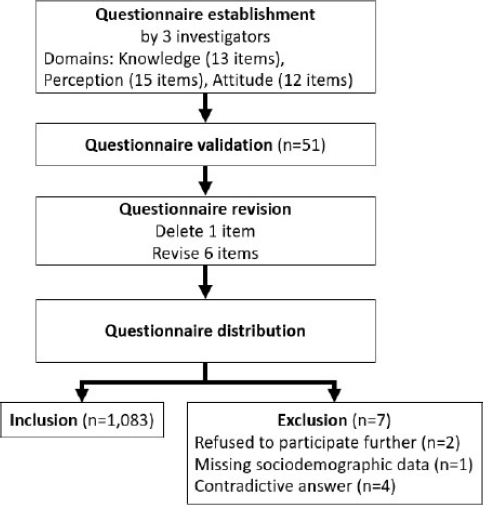
Flowchart of study.
For the knowledge section, the Guttman scale was employed to distinguish between correct (score 2) and incorrect (score 1) responses. For the perception and attitude sections, a five-point Likert scale was used, consisting of the options: strongly disagree, disagree, doubtful, agree, and strongly agree. The questionnaire was distributed via Google Forms to dental and medical institutions throughout Indonesia, as well as to members of the Indonesian Dental Association (PDGI) and the Indonesian Medical Association (IDI).
2.3. Questionnaire Validation
The questionnaire was validated using data from 51 participants and analyzed using the Rasch model. The Cronbach's alpha (KR-20) coefficient was 0.83, with a standard error of measurement (SEM) of 3.94. Person reliability was 0.81 with a separation index of 2.07, while item reliability was 1.00 with a separation index of 42.57. The unidimensionality test indicated that the unexplained variance in the first contrast was 3.94. Item fit statistics showed that both infit and outfit mean square (MNSQ) values ranged from 0.5 to 2.0, except for one item in the perception domain, which exhibited a high infit MNSQ value. This item was removed, and six additional items were revised. Based on these psychometric indicators, the questionnaire was considered to have satisfactory construct validity [14].
2.4. Subject Recruitment
Participants were categorized into six groups based on the following criteria: dental students, medical students, dentists, medical doctors, dental specialists, and medical specialists. Inclusion criteria included students who had completed at least four preclinical semesters and licensed healthcare practitioners (dentists or physicians). Exclusion criteria were incomplete responses or inconsistent sociodemographic information. Informed consent was obtained from all subjects before initiation of the study.
2.5. Data Analysis
The Rasch model was applied to analyze the item–person distribution across groups, and the results were illustrated using a Wright map. The Chi-square test was applied to compare the proportions among groups. Although the Shapiro-Wilk test indicated a significant deviation from normality (p<0.05), the large sample size in this study (n=1,083) supports the assumption of approximate normality based on the central limit theorem [15, 16]. Therefore, ANOVA was considered appropriate, particularly when supplemented with robust methods, such as Welch’s ANOVA to address potential heterogeneity of variance.
ANOVA was used to compare the knowledge, perception, and attitude scores, while Welch’s ANOVA was specifically applied to the knowledge scores. Levene's test indicated unequal variances for knowledge scores (F=15.215, p<0.001), while the assumption of homogeneity of variance was met for perception (F=0.256, p=0.906) and attitude (F=0.353, p=0.842). Multicollinearity diagnostics indicated no violation of multicollinearity among the independent variables, with a tolerance of 1.000 and a VIF of 1.000. Post hoc analyses were conducted using the Games–Howell test for knowledge and attitude, and the Least Significant Difference (LSD) test for perception. Mediation analysis using the bootstrap for 5,000 resamples was performed to examine the mediating effects within the model. Linear regression analysis was also conducted to identify factors contributing to knowledge, perception, and attitude. Statistical significance was set at p<0.05.
3. RESULT
3.1. Participant Characteristics
Of the 1,090 subjects initially recruited, seven were excluded due to withdrawal from participation (n=2), missing sociodemographic data (n=1), or contradictory responses (n=4) (Fig. 1). Consequently, a total of 1,083 participants were included in the final analysis, consisting of 22.9% males and 77.1% females (Table 1). The mean age of dental students was 21.21±2.12 years, while that of medical students was 21.72±1.16 years. The majority of participants were dental students (69.9%), followed by dentists (20.1%). No medical specialists participated in this study. Most dental specialists were from conservative dentistry (45.8%), followed by pediatric and periodontic specialities.
| Variable | n (%) |
|---|---|
| Gender | |
| Male | 248 (22.9) |
| Female | 835 (77.1) |
| Age in years [mean(SD)] | |
| Student dental | 21.21 (2.12) |
| Student medical | 21.72 (1.16) |
| Dentist | 39.06 (11.67) |
| Medical doctor | 37.68 (13.3) |
| Dental specialist | 39.70 (7.73) |
| Status | |
| Student dental | 757 (69.9) |
| Student medical | 44 (4.1) |
| Dentist | 218 (20.1) |
| Medical doctor | 16 (1.5) |
| Dental specialist | 48 (4.4) |
| Dental specialist (n=48) | |
| Oral surgery | 3 (6.3) |
| Dental forensic | 1 (2.1) |
| Conservative dentistry | 22 (45.8) |
| Orthodontics | 1 (2.1) |
| Pediatrics dentistry | 7 (14.6) |
| Periodontics | 6 (12.5) |
| Oral medicine | 5 (10.4) |
| Prosthodontics | 3 (6.3) |
3.2. Learning Experience and Item Analysis
As shown in Table 2, dental students reported the least prior exposure to training in heart attack and anaphylaxis, whereas dentists and medical doctors reported greater exposure and more practical training experience. Moreover, significant differences were observed among groups in past learning experiences related to heart attack (p=0.019) and modes of learning for heart attack (p<0.05), as well as in past learning experiences for anaphylactic shock (p<0.001) and modes of learning for anaphylactic shock (p<0.05). Figure 2 illustrates the Wright map, which presents a comparative distribution of items and participants. The right panel displays item difficulty, while the left panel depicts the distribution of participants across ability levels within each professional group. The Wright map demonstrated good targeting between item difficulty and participant ability, with minimal ceiling effect, suggesting that the items effectively captured the full range of respondent competencies across all groups.
| Variable |
Student Dental n=757 n (%) |
Student Medical n=44 n (%) |
Dentist n=218 n (%) |
Medical Doctor n=16 n (%) |
Dental Specialist n=48 n (%) |
p-value |
|---|---|---|---|---|---|---|
| Heart Attack | ||||||
| Past learning Never Did not remember Ever |
77 (10.17) 41 (5.41) 639 (84.41) |
- - 44 (100) |
11 (5.04) 7 (3.21) 200 (91.74) |
- - 16 (100) |
3 (6.25) 3 (6.25) 42 (87.5) |
0.019* |
| Mode of learning Theory Demonstration Manekin used |
680 (89.82) 425 (56.14) 345 (45.57) |
44 (100) 37 (84.09) 30 (68.18) |
207 (94.95) 150 (68.8) 111 (50.91) |
16 (100) 13 (81.25) 13 (81.25) |
45 (93.75) 32 (66.66) 26 (54.16) |
0.017* <0.001** 0.002** |
| Anaphylaxis | ||||||
| Past learning Never Did not remember Ever |
76 (10.03) 37 (4.88) 644 (85.07) |
- - 44 (100) |
6 (2.75) 6 (2.75) 206 (94.49) |
- - 16 (100) |
1 (2.08) - 47 (97.91) |
<0.001** |
| Mode of learning Theory Demonstration Manekin used |
681 (89.96) 297 (39.23) 167 (22.06) |
44 (100) 20 (45.45) 10 (22.72) |
212 (97.24) 114 (52.29) 60 (27.52) |
16 (100) 12 (75) 6 (37.5) |
47 (97.91) 26 (54.16) 19 (39.58) |
<0.001** <0.001** 0.027* |
| Experience | ||||||
| Do resucitation See others doing Family member history due to heart attack anaphylaxis |
61 (8.05) 293 (38.7) 70 (9.24) 27 (3.56) |
27 (61.36) 34 (77.27) 3 (6.81) - |
11 (5.04) 103 (47.24) 37 (16.97) 12 (5.5) |
10 (62.5) 13 (81.25) 4 (25) 1 (6.25) |
4 (8.33) 24 (50) 9 (18.75) 2 (4.16) |
<0.001** <0.001** 0.002** 0.438 |
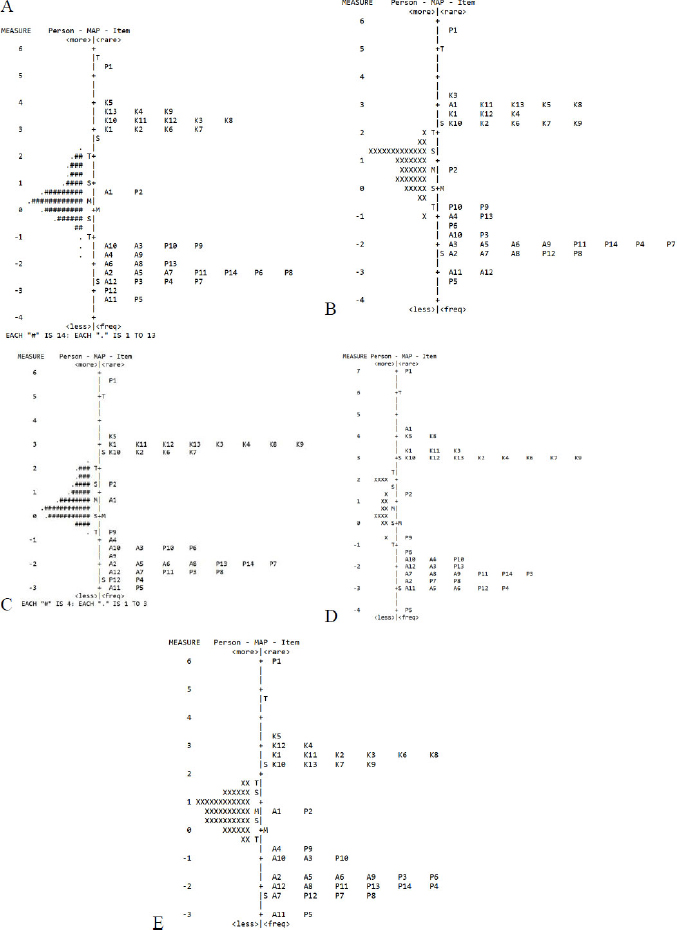
The Wright map showed the distribution of items (K for knowledge, P for perception, and A for attitude) for each group (A. dental student; B. medical student; C. dentist; D. medical doctor; E. dental specialist).
3.3. Comparison of Knowledge, Perception and Attitude
Medical students consistently scored higher in knowledge (25.47±1.02) and perception (55.36±5.4) than other groups, whereas dental students had the lowest scores in all domains. Table 3 presents the ANOVA test results, which revealed significant differences among groups in knowledge (p<0.001; Fig. 3A), perception (p=0.013; Figure 3B), and attitude (p<0.001; Fig. 3C). Post hoc analysis (Fig. 3) indicated that dental students had lower scores across all domains than other groups, whereas medical students had the highest scores. Figure 3 supports these findings, illustrating higher overall means among medical students than in all other groups.
| Variable |
Student Dental Mean (SD) |
Student Medical Mean (SD) |
Dentist Mean (SD) |
Medical doctor Mean (SD) |
Dental specialist Mean (SD) |
p-value η2 |
|---|---|---|---|---|---|---|
| Knowledge | 24.94 (1.54) | 25.47 (1.02) | 25.40 (0.98) | 25.56 (0.62) | 25.56 (0.76) | <0.001** 0.027 |
| Perception | 53.66 (4.83) | 55.36 (5.4) | 53.99 (5.01) | 55.37 (4.86) | 55.37 (5.14) | 0.013* 0.010 |
| Attitude | 46.70 (5.27) | 50.79 (4.83) | 47.98 (5.01) | 49.87 (5.3) | 48.77 (4.41) | <0.001** 0.037 |
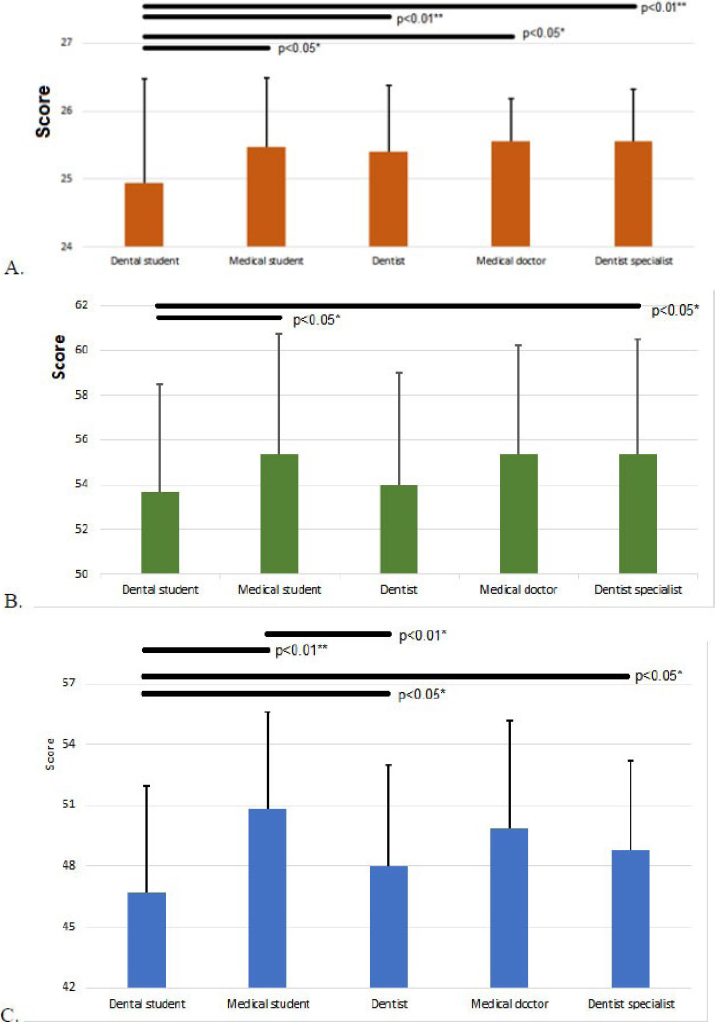
Post hoc test comparison of knowledge (A), perception (B), and attitude (C) scores for each group. (* p<0.05; ** p<0.01).
3.4. Regression and Bootstrap Mediation Analysis
Figure 4A presents the scatter plot from the regression analysis of attitude scores, on which a model was based on the significant relationships among knowledge, perception, and attitude variables. The unstandardized coefficient from knowledge to perception was 1.162 with a standard error of 0.100, while the coefficient from perception to attitude was 0.551 with a standard error of 0.028. Bootstrap mediation analysis demonstrated a significant mediating effect of perception on the relationship between knowledge and attitude (p<0.001) (Fig. 4B). This suggests that greater knowledge indirectly enhanced attitudes through improved perception.
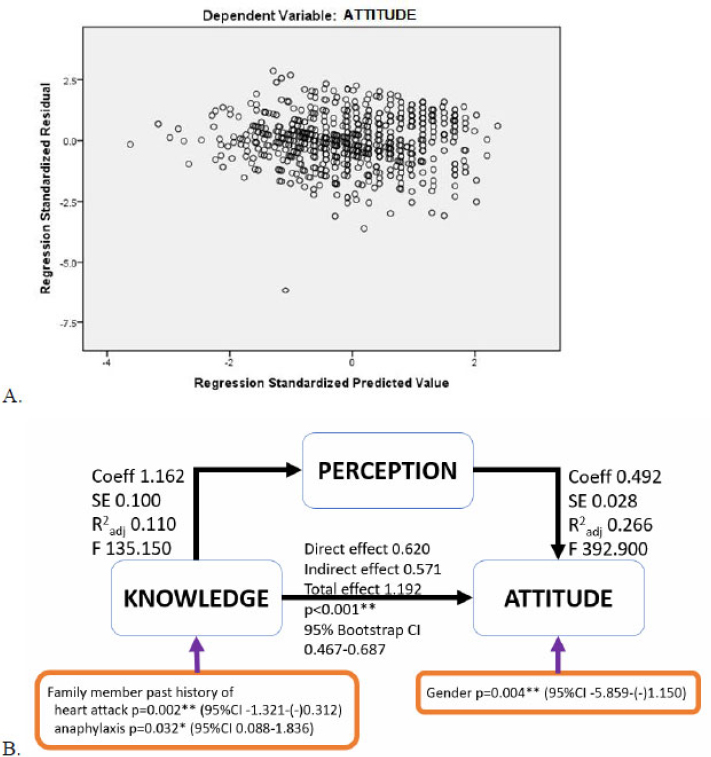
A. Scatterplot of knowledge and perception towards attitude. B. Proposed model of heart attack and anaphylactic shock (black arrow indicates bootstrap mediation analysis between knowledge, perception, and attitude; purple arrow indicates logistic regression analysis).
Linear regression analysis identified several significant factors influencing knowledge and attitude. Participants with a family history of heart attack or anaphylaxis showed significantly higher knowledge scores (p<0.05), while gender was found to significantly influence attitude (p=0.004).
4. DISCUSSION
Basic life support education has been widely studied in various countries and curricula, often focusing on cardiac arrest and emergency response. However, limited attention has been paid to the combined knowledge, perception, and attitude toward both heart attack and anaphylactic shock in dental and medical settings. Given both conditions, resuscitative intervention may be necessary in clinical settings; health workers and trainees should be adequately prepared to respond swiftly. This study deepens understanding by exploring predictors and interrelationships among knowledge, perceptions, and attitudes across diverse subgroups (students, clinicians, and specialists) in dentistry and medicine.
4.1. Instrument Development and Validation
To ensure high quality, three certified instructor-investigators developed the questionnaire, grounded in domain-specific frameworks and with attention to subgroup relevance (Fig. 1). Using the Rasch model, this study confirmed stable item functioning across subgroups; misfitting items were revised and removed, thus overall person-item targeting was acceptable [14]. Such rigorous instrument validation aligns with recommendations for applying the Rasch model in health education measurement to improve precision and ensure construct validity [12, 13]. The Wright map further suggests that item difficulty distribution corresponded well with respondent ability levels across groups, reducing the likelihood of bias toward any subgroup.
4.2. Participant Characteristics
The sample was heavily skewed toward female subjects (77.1%, Table 1), a pattern observed in other studies of health professional trainees, especially in dentistry and allied health fields. Dagli et al. observed female predominance in attitude and behaviour surveys among dental students [17]. While imbalanced gender or subgroup proportions, such as dental students (69.9%) and dentists (20.1%), potentially threaten generalizability, our combination of robust statistical methods (Welch’s ANOVA, Games-Howell, regression adjustment) and psychometric validation (Rasch model) helps to minimize bias. Although Welch’s ANOVA, Games–Howell post hoc analysis, regression adjustment, and Rasch modelling were used to address unequal group sizes, variance heterogeneity, and measurement properties, these statistical approaches could not eliminate selection bias resulting from convenience sampling. Therefore, the results should be interpreted with caution and not considered representative of the entire Indonesian healthcare population.
4.3. Learning Experience Differences
Significant differences in past learning, learning modes, and practical experience were found across groups (p<0.05), except for family history of anaphylaxis (Table 2). These disparities likely reflect curricula emphases, which medical programs often embed cardiac emergency training more thoroughly than dental curricula. In many contexts, dental education and training place great emphasis on complications of local anesthesia and allergic reactions, which may explain the relative strength of knowledge about anaphylaxis [18, 19]. Prior literature showed that health students’ exposure to basic life support training is uneven across disciplines. A study in India demonstrated that many dental students had limited exposure to basic life support or cardiopulmonary training [20]. These results support the findings that mode and frequency of exposure play a role in shaping knowledge, perception, and attitude profiles [20-22].
4.4. Wright Map Interpretation
Figure 2 shows a Wright map in which most items were distributed similarly with respect to person ability across groups, confirming measurement invariance. Almost all items (right side) showed similar distribution against person logit. Notably, for item A1 (“In patients with cardiac arrest, I provide cardiopulmonary resuscitation”) had higher logit values for medical students and doctors than for dental students and dentists. This suggests that resuscitation knowledge for cardiac arrest is more advanced in medical curricula, consistent with the literature showing that medical students outperform dental peers in cardiac arrest competencies [23]. Conversely, dentists may receive comparatively more training in managing allergic or anaphylactic conditions, which could reflect their focus on anesthesia and potential allergic reactions. This pattern underscores the need to integrate cardiac emergency content equally into dental education, given that ischemic cardiac events remain among leading causes of mortality globally.
4.5. Domain-specific Differences
Across all domains, dental students scored significantly lower than other groups in knowledge (24.94 ± 1.54), perceptions (53.66 ± 4.83), and attitudes (46.70 ± 5.27) (p < 0.05) compared to other groups (Table 3, Fig. 3). Medical students consistently achieved the highest scores. These findings echo prior knowledge, attitude, and practice surveys in health education, which often reveal that students in non-medical disciplines lag in the emergency domain [24]. Agnibhoj and Patidar et al. found deficits in basic life support knowledge and practice among dental students before the intervention [25]. Differences in clinical exposure, curriculum, reinforcement, and motivational factors could partly explain this pattern.
Although the health worker group differed statistically in knowledge, perception, and attitude, its contribution to explaining these outcomes was relatively modest (Table 3). This suggests that being a medical student, dental student, dentist, or physician alone was not the primary determinant of BLS competence-related outcomes. Instead, individual educational experiences and other unmeasured factors likely play a much larger role, such as previous BLS training, recency of training, clinical experience, motivation, self-directed learning, exposure to emergencies, institutional differences, or other individual characteristics not measured in this study [24].
4.6. Bootstrap Mediation and Regression Findings
The scatter plot of residuals showed a random, homoscedastic pattern with no extreme outliers, supporting the validity of the regression model (Fig. 4A). The bootstrap mediation analysis showed a significant indirect pathway (knowledge to perception to attitude), implying that perception partially mediates the effect of knowledge on attitude (p<0.001, Fig. 4B). This aligns with theoretical models in health education, in which knowledge may enhance beliefs or perceptions, thereby shaping attitudes and ultimately practice or behaviour [26-28]. Similar mediation patterns have been reported in knowledge-attitude-practice studies in other domains. However, the study conducted by Wang et al. reported that practice was indirectly influenced by knowledge through the mediating role of attitude, while perceived barriers had a negative effect on infection control behavior [29]. This contrasting finding may be attributed to differences in how individuals perceive the severity or life-threatening nature of the condition.
Regression analysis revealed that family history of heart attack (p=0.002; 95% CI -1.321-(-)0.312) and history of anaphylaxis exposure (p=0.032; 95% CI 0.088-1.836) were significant predictors of knowledge domain, suggesting that personal relevance or exposure motivates learning (Fig. 4B). Students and clinicians with a family history of cardiac arrest or anaphylaxis tend to acquire deeper knowledge and understanding, driven by the motivation to be able to assist their own family members more effectively compared to when such conditions occur in unrelated individuals [30]. Comparable observations have been made in basic life support studies, in which individuals with prior exposure or personal connections often score higher [31]. The findings that gender (p=0.004; 95% CI -5.859-(-)1.150) predicted attitude is consistent with literature showing variable gender based differences in confidence or willingness to act in emergencies. Male students or clinicians demonstrated greater responsiveness and readiness to perform Basic Life Support than their female counterparts.
4.7. Educational Implications
Overall, these results support a knowledge-to-perception-to-attitude pathway, suggesting that boosting conceptual understanding alone may not suffice. Educational interventions must also address perceptions, such as risk awareness or confidence, to shift attitudes, readiness, and willingness. Several educational recommendations could be proposed from this study. First, BLS education should be strengthened within dental curricula, as dental students in this study had lower knowledge scores than those in other professional groups. Although BLS education is taught in both medical and dental curricula, greater curricular emphasis, reinforcement, and repeated exposure may be beneficial in dental training. Second, periodic courses and simulation-based training should be provided throughout undergraduate and professional education. These activities may help reinforce knowledge, improve confidence and preparedness, and promote more positive attitudes toward managing medical emergencies. Third, future educational programs should evaluate not only theoretical knowledge but also practice skills. These psychomotor skills is an essential component of effective emergency management and could not be adequately assessed through self-reported questionnaires alone. Interprofessional training that brings dental and medical learners together may help equalize exposure and attitudes across groups.
4.8. Limitations
The primary limitation of this study was the potential for selection bias arising from convenience sampling and the unequal representation of subject groups. Dental students constituted the majority of the sample, while medical students, medical doctors, and dental specialists were represented by substantially smaller numbers. Gender female subjects were also predominant. Thus, the study sample may not adequately represent the broader population of healthcare students and professionals in Indonesia, and the findings should not be generalized to the entire Indonesian healthcare population. However, both the statistical approach and the Rasch model helped describe, at least, minimize any potential bias arising from this imbalance. The Rasch model confirmed that items functioned consistently across subgroups as illustrated in the Wright map. The Wright map also demonstrated a balanced item-person distribution across groups, indicating that the measurement model was not biased toward any specific subgroup. Furthermore, ANOVA or Welch’s ANOVA, with Games-Howell post hoc tests, were applied; these methods are robust to unequal group sizes and heterogeneous variances [32, 33]. Regression analysis was also performed, adjusting for group membership and other covariates to ensure that group imbalance did not distort parameter estimates. These statistical methods could not eliminate the possibility of selection bias or compensate fully for the non-probability sampling method.
CONCLUSION
This study provides evidence that knowledge, perceptions, and attitudes regarding heart attack and anaphylactic shock may differ among dental and medical students and professional groups, with dental students showing the lowest scores and medical students the highest. The validated questionnaire provided strong psychometric properties under Rasch analysis, supporting its use in future educational evaluations. Bootstrap mediation analysis revealed that perception significantly mediates the relationship between knowledge and attitude. Moreover, family history and gender emerged as significant predictors of knowledge and attitude, respectively. These findings underscore the need for targeted, interdisciplinary, simulation-based Basic Life Support training, especially for dental students. Importantly, the results suggest that enhancing knowledge alone may be insufficient unless perception, confidence, and preparedness are simultaneously strengthened. Addressing these interconnected factors is essential to ensure healthcare trainees are fully equipped to manage life-threatening emergencies effectively in clinical settings.
AUTHORS’ CONTRIBUTIONS
The authors confirm contribution to the paper as follows: W.P., I.G.: Study conception and design; Y.Y., J.W., J, A.A.: Data collection; A.A.: Funding; I.G.: Analysis and interpretation of results; W.P.: Draft manuscript; W.A., E.F.S.: Reviewing and editing. All authors reviewed the results and approved the final version of the manuscript.
LIST OF ABBREVIATIONS
| BLS | = Basic life support |
| IDI | = Indonesian Medical Association |
| LSD | = Least significant difference |
| MNSQ | = Mean square |
| PDGI | = Indonesian Dental Association |
ETHICS APPROVAL AND CONSENT TO PARTICIPATE
Ethical approval for this study was obtained from the Ethics Committee of the Faculty of Dentistry, Universitas Trisakti (047/S3/KEPK/FKG/7/2024).
HUMAN AND ANIMAL RIGHTS
The study was conducted in accordance with the Declaration of Helsinki and the International Good Clinical Practice guideline.
CONSENT FOR PUBLICATION
Informed consent was obtained from all subjects before initiation of the study.
AVAILABILITY OF DATA AND MATERIALS
Data may be shared by the corresponding author upon reasonable request.
ACKNOWLEDGEMENTS
Declared none.